What Is a Credit Score and Why Does Having No Credit History Hurt You in South Africa?

Thousands of South Africans are declined for a home loan, a car loan, or even a store account — not because they have bad credit, but because they have no credit at all. Lenders use your credit profile to decide whether to trust you with money. No profile means no trust, and no trust means no approval.
This guide covers how to build credit South African consumers can actually use: what a credit score is, how the credit bureau system works, what types of credit accounts (revolving credit like store cards and credit cards, instalment credit like personal loans, and secured credit like vehicle finance) count towards your profile, and the practical first steps to start.
How Do You Build Credit Without Getting into Bad Debt?
The National Credit Act (NCA) regulates all credit in South Africa, but the most important protection from bad debt is your own behaviour. Building a strong credit profile and falling into bad debt are not the same thing, yet many South Africans do both at once. Here is how to use credit as a profile-building tool without getting into bad debt:
Spend only what you already have: Treat your store account like a debit card. The National Credit Regulator (NCR) notes that most South Africans who fall into bad debt do so because they treat credit as additional income rather than a repayment obligation. Buy only what you would have bought with cash, then pay the full balance before your statement closing date.
Request a deliberately low opening limit: Starting with a R500–R2,000 limit removes the temptation to overspend. TFG, Truworths and Identity for example, all allow you to request a low limit at application. After 6–12 months of clean history, you can request an increase.
Set up a debit order for the full balance - not just the minimum: The Credit Ombud explains that minimum-payment cycles are one of the most common routes into bad debt. Paying the full outstanding amount each month means you never pay interest and your utilisation resets to zero every cycle.
Never use credit to cover a shortfall you cannot repay within 30 days: Using a store account for a rent gap you cannot repay creates bad debt, not a credit profile. Build a cash emergency fund before relying on credit as a safety net.

What Is a Credit Score and Why Does It Matter in South Africa?
Your credit score is a 3-digit number out of a 1,000 or a percentage out of 100 in South Africa — that summarises how responsibly you manage borrowed money. Every time you pay a bill on time, apply for credit, miss a payment, or open a new account, that information is recorded in your credit profile and used to calculate your score.
What affects credit score calculations in South Africa? The main five factors are payment history (35%), credit utilisation (30%), credit age (15%), credit mix (10%), and new enquiries (10%). Understanding what affects credit score movement is the foundation of managing it deliberately.
Lenders, landlords, and even some employers use your credit score to make decisions about you. A higher score means lower perceived risk — and lower risk means better terms, better rates, and better access to the financial products that help you build a life.
Here is what the score bands mean in the South African context:
0% - You don’t have a credit score
1-20% - Very high risk
21-40% - High risk
41-60% - Medium risk
61-80% - Low risk
81-100% - Very low risk

Why Does Having No Credit History Hurt You in South Africa?
Most people assume that having no debt means having a clean financial record. In credit terms, that is only half true. If you have never borrowed before, the credit bureaus have no data on you, and no data is treated by lenders almost as badly as bad data.
When a lender checks your credit profile and finds nothing, they cannot assess your risk. They do not know whether you are disciplined with money or chaotic. From their perspective, you are an unknown, and unknown risk is risk they are reluctant to take on.
This is the credit paradox: you need a credit record to get credit, but you need credit to build a credit record. The only way through it is to take one deliberate, low-risk first step — which is exactly what Article 2: Which Credit Account Should I Open First? in this series covers in detail.
How Do South African Credit Bureaus Work?
South Africa has more than 20 registered credit bureaus. The main retail bureaus include TransUnion, Experian, XDS (Xpert Decision Systems), and Compuscan (now owned by Experian). These organisations collect and store financial data on South African consumers — every credit account you open, every payment you make or miss, and every time you apply for credit is recorded.
Lenders report your account activity to the South African Credit and Risk Reporting Association (SACRAA), which distributes this data to the relevant bureaus, typically on a monthly basis. Each bureau then uses that data to generate a credit report and calculate a credit score. Because not all lenders report to the same bureaus, your score may differ slightly between them — this is completely normal.
Under the National Credit Act (NCA), you are entitled to one free credit report per year from each bureau. The Sanlam Credit Dashboard consolidates your credit data in one place, updated monthly, so you can track your progress without navigating multiple platforms separately.

What Are the First Steps to Building a Credit Profile in South Africa?
Whether you are looking for a credit score for beginners in SA guide or you simply want to build credit from scratch in SA with as little risk as possible, the path is the same. The easiest credit account to open in South Africa is a cell phone contract or store account — both are accessible, low-risk, and reported to the major bureaus. Here is a step-by-step guide:
Step 1: Understand where you stand. Use the Sanlam Credit Dashboard to check whether you have an existing credit profile. If you have ever had a cell phone contract, store account, or any loan, you likely have some credit history already.
Step 2: Choose a starting point. For most South Africans, a store account (Truworths, Identity, or TFG) or a cell phone contract is the lowest-friction entry point. Approval requirements are lower and the risk of overspending is contained.
Step 3: Apply for one account at a time. Every credit application creates a hard enquiry on your report that temporarily lowers your score. Apply for one product, wait for the outcome, and then decide on your next steps. Never apply for multiple accounts simultaneously.
Step 4: Activate and use the account every month. An account you never use does not build your credit profile. Make a small purchase each month — even if it’s just R50 — and pay it off in full before the due date.
Step 5: Set up a debit order. The single biggest threat to a new credit profile is a missed payment. Set up a debit order for at least the minimum payment on every account and manually pay more when you can.
Step 6: Track your credit score monthly. Log into the Sanlam Credit Dashboard each month to see whether your score is moving in the right direction. Your credit management coach will show you exactly what is driving your score — and what to do about it.
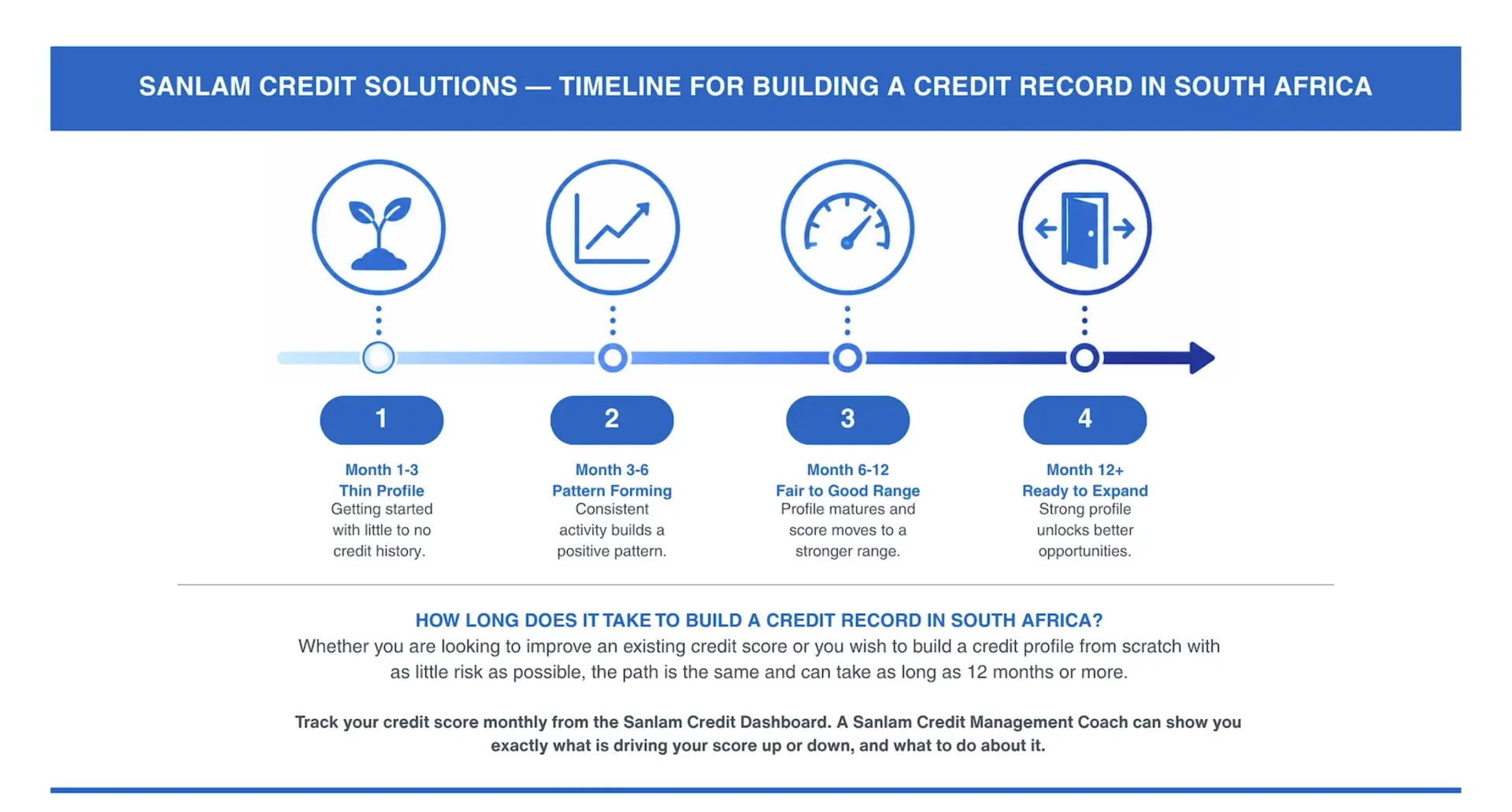
How Long Does It Take to Build a Credit Record in South Africa?
Month 1–3: Your account is opened and reported to the bureaus. You now have a credit profile, but it is thin. Lenders can see you exist but cannot yet assess a pattern of behaviour.
Month 3–6: With consistent on-time payments, your score starts to establish itself. This is the most critical window as a single missed payment at this stage can set you back significantly.
Month 6–12: A track record is forming. Your score should be moving into the fair-to-good range if your repayment behaviour has been consistent. You may begin to qualify for a credit card or an additional credit product.
Month 12+: You now have a meaningful credit history. If you have managed everything correctly, you are in a position to consider expanding your credit profile — which is exactly what Article 2: Which Credit Account Should I Open First? in this series covers.
What Are the Most Common Mistakes That Damage Your Credit Score From Day One?
There are some common mistakes people make when applying for credit, namely:
Applying for multiple accounts at once: Each application generates a hard enquiry. Multiple enquiries in a short period signal financial desperation to lenders and lower your score. Space applications at least three to six months apart.
Missing even one payment: Payment history is the single biggest factor in your credit score, approximately 35%. One missed payment can cost 5 to 10% and take months to recover from.
Using too much of your available limit: Keeping your credit utilisation above 30% of your limit consistently signals financial stress to lenders. Aim to always keep your balance below 30% of your credit limit.
Closing your first account too soon: Your oldest account contributes positively to your credit age score factor. Close it and you lose that history. Keep early accounts open even if you rarely use them.
Try to avoid these to build and maintain a healthy credit score.
The Biggest Mistakes That Trap People in Debt Early
The NCR reports that over-indebtedness remains one of the most common financial challenges facing South African consumers. These are the specific patterns that trap people in debt cycles early:
Applying for multiple accounts at once: Sipho, 26, applied for a store card, credit card and a personal loan with different credit providers all in the same week. Each application created a hard enquiry on his credit bureau profile. His score dropped approximately 4% before any account was even approved — and two applications were declined because the drop made him appear higher-risk. Remember, it's ideal to make one application at a time with a minimum of three months apart.
Paying only the minimum every month: The NCA states the maximum interest rate on store accounts is 27.75% per annum. At this rate, a R2,000 balance paid at minimum for 18 months can cost more in interest than the original purchases. Some retailers charge up to this NCA maximum. Always pay the full outstanding balance when possible.
Using credit for lifestyle spending above your income: Lerato, 29, used her store account to fund clothing purchases she could not afford from her salary. Within six months her utilisation was above 90%, her Experian score had dropped to approximately 48%, and she was paying R280 per month in interest on a R1,600 balance she could not clear. Only use credit for expenses already budgeted in your income.
Ignoring missed payment notifications: The Credit Ombud confirms that a single 30-day missed payment is reported to all bureaus simultaneously through SACRAA. At 90 days, the account is classified as a default — which remains on your credit record for up to two years even after the debt is settled.
Why was I declined for credit when I have never borrowed before?
No credit history is treated almost as badly as bad credit by most lenders as they simply cannot assess your risk. Open a starter account (store card or cell phone contract), manage it for six months, and then reapply.What is a good credit score in South Africa?
Above 670 (70%) is generally considered good. Above 740 (80%) is very good. Above 800 (90%) qualifies you for the best available interest rates. The Sanlam Credit Dashboard shows your current score band as a percentage and what it means for your borrowing power.Is it bad to have no credit history?
Yes, from a lender's perspective. No credit history means no evidence of how you manage borrowed money. Lenders treat unknown risk as high risk. Starting a credit profile deliberately, with one manageable account, is always better than having none.How do SA credit bureaus differ from one another?
Each bureau receives data from different lenders, so your score may vary between them. TransUnion and Experian are the most widely used by major lenders. XDS and Compuscan are more niche but still relevant. Most lenders check one or two specific bureaus when assessing an application.Does a cell phone contract build my credit score?
Yes, it does provided the mobile network (Vodacom, MTN, Cell C, Telkom) reports to a credit bureau, which most major networks do. Pay your contract on time every month and it contributes positively to your payment history.
What Is Your Next Step on the Credit Confidence Journey?
Understanding your credit score and why it matters is the foundation. Now the next question is the one most South Africans find hardest to answer: which credit account should I open first?
Article 2: Which Credit Account Should I Open First? in this series (Beginner Credit Products) gives you a complete comparison of store accounts, credit cards, cell phone contracts, and student-friendly options, with a clear recommendation based on your income and situation.