Which Credit Account Should I Open First in South Africa?

You know you need a credit profile. You know you need to start somewhere. But when you look at the options (store accounts, credit cards, cell phone contracts, personal loans, student accounts) the choice feels overwhelming. This guide identifies the best starter credit option for each situation, so you can open the right account with confidence.
This article cuts through that confusion. It compares every beginner credit product available in South Africa, tells you, which is easiest to qualify for, and gives you the exact steps to maximise your chances of approval. By the end, you will know exactly which account to open first and why.

Store Account vs Credit Card: Which Should You Open First in South Africa?
This is the most-searched beginner credit question in South Africa, and the honest answer depends on your income and your financial discipline.
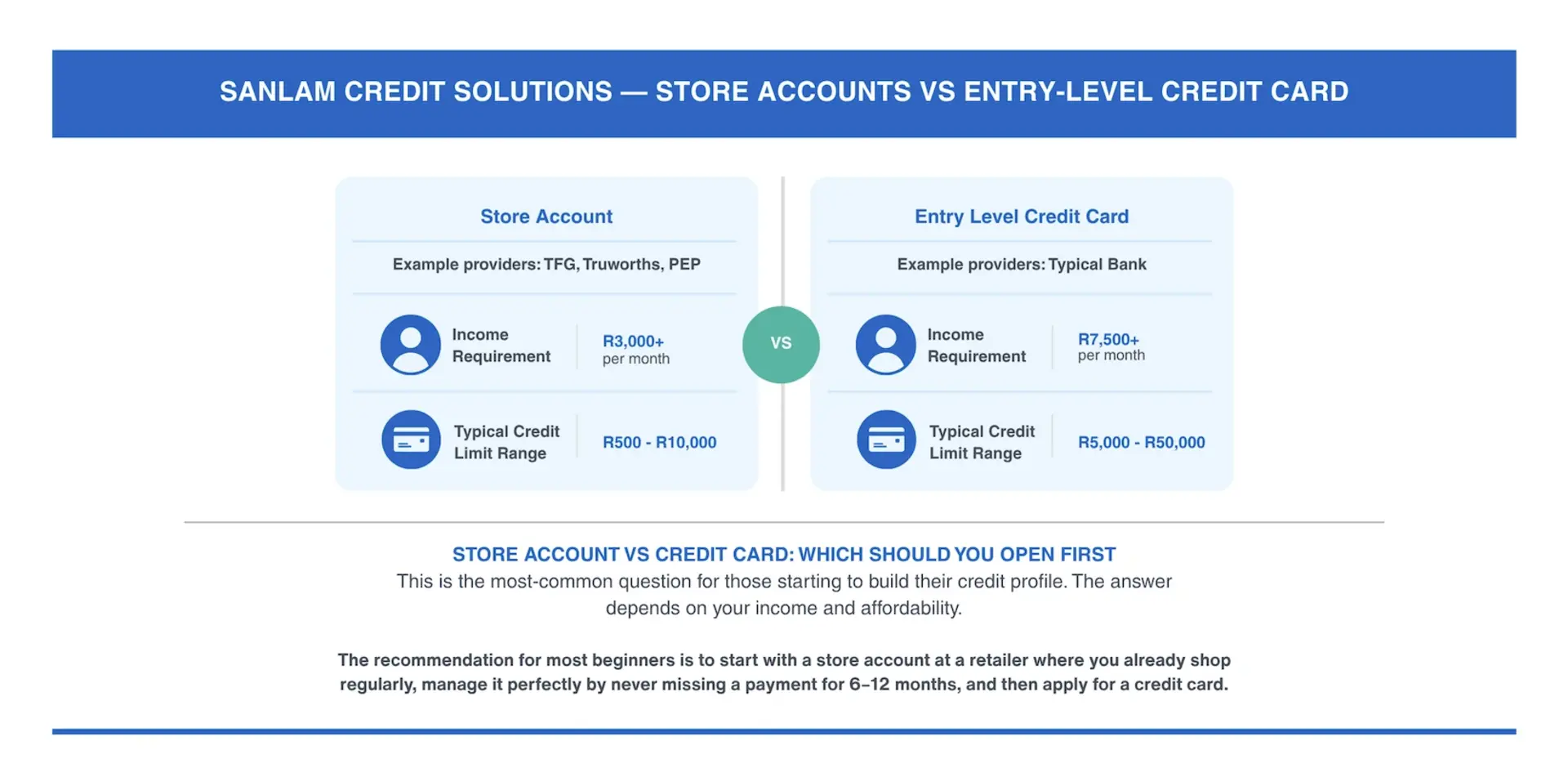
A store account is issued by a retailer (Truworths, Identity, TFG) and can only be used in that store or group. Income requirements are typically lower than a bank credit card, the application process is faster, and the approval threshold is more accessible for first-time credit applicants.
A credit card is issued by a bank or registered credit provider and can be used anywhere that accepts card payments. It has a stronger positive impact on your credit profile over time because it is a revolving line of credit used monthly and reported monthly. However, it requires more financial discipline and the flexibility that makes it powerful can also make it risky.
The recommendation for most beginners: start with a store account at a retailer where you already shop regularly, manage it perfectly for 6–12 months, and then apply for a credit card. This sequence builds a track record before you take on a more complex product.
The recommendation for beginners with a stable income and strong discipline: an entry-level credit card can be a strong starting point. Look for credit providers with accessible approval thresholds and low minimum income requirements.

Does a Cell Phone Contract Build Your Credit Score in South Africa?
Do cell phone contracts build credit? Absolutely, but with an important condition. A cell phone contract only builds your credit profile if the mobile network reports your payment behaviour to a credit bureau. The good news is that most major South African networks (Vodacom, MTN, Cell C, Telkom) do report to bureaus.
Every on-time monthly payment is recorded and contributes positively to your payment history which is the single biggest factor in your credit score (approximately 35%). A two-year cell phone contract that you pay on time every month provides 24 months of positive payment history.
The limitation: a cell phone contract is counted as a single instalment product. It builds payment history well but does not give you revolving credit (the ability to spend, repay, and spend again), which is what lenders look for when assessing your credit mix. Think of it as a good starting point or a supplement — not a complete solution on its own.
Student tip: If you are a student or recent graduate with limited income, a cell phone contract is often the most accessible credit product available. It requires no deposit, is widely approved, and starts building your credit profile immediately without the risk of carrying a credit card balance.
What Are the Easiest Credit Accounts to Open in South Africa?
Easiest: Cell phone contract. Widely approved with any regular income. Requires your SA ID, proof of income or bank statement, and proof of residence. MTN, Vodacom, Cell C, and Telkom all offer entry-level contracts under R200/month that qualify.
Easy: Store account. Lower income requirements than bank credit cards. Applications at in-store and online via digital platforms are processed quickly. Most retailers, such as TFG, Truworths and Identity, all have accessible entry-level store credit.
Moderate: Entry-level credit card. Standard Bank Blue, Absa Gold, FNB Aspire, and Nedbank Gold are all designed for first-time credit card applicants. Income requirements range from approximately R5,000 per month.
More difficult: Personal loan. Requires existing credit history for most lenders. If you have no credit record, most credit providers will decline or offer very small loan amounts at high rates. Build a track record on a simpler product first.
What Are the Best Student-Friendly Credit Options in South Africa?
Students and young people (typically 18–25) face a particular challenge: most credit products require proof of income, which full-time students do not have. However, there are accessible options specifically designed for this segment:
Student cell phone contract: The most accessible product for students. Many networks offer contracts at R150–R300 per month that can be approved with an employment contract and proof of income, or part-time income. Cell phone providers require proof of employment and income verification. Major banks offer student credit cards for registered students at South African universities. These typically have lower limits (R1,000–R5,000) and require proof of student registration plus a parental surety or existing student bank account.
Part-time income qualifier: If you have any form of regular income (part-time work, a bursary allowance, or a regular parental contribution) this can be used as proof of income for entry-level credit products. A bank statement showing regular deposits is typically sufficient.
What to avoid: Avoid Buy Now Pay Later (BNPL) credit agreements at this stage, as these can create hidden debt obligations. Also avoid payday loans, microloans, and informal credit providers at the beginning of your credit journey. These carry extremely high interest rates, and their repayment patterns do not always report to bureaus in a way that helps your score.
How Do You Maximise Your Chances of Approval for Your First Credit Account?
Check your existing credit profile first. Even if you have never consciously taken on credit, a cell phone contract or retail account may have been opened in your name. Check the Sanlam Credit Dashboard or request a free bureau report before applying.
Make sure your documents are in order. You will typically need: valid SA ID or passport, latest three payslips or three months of bank statements, proof of residence not older than three months, and your bank account details.
Apply at a bank or retailer where you already have a relationship. An existing current account or savings account gives a lender more data on your financial behaviour and increases approval odds.
Apply for one product only. Multiple applications in a short period create multiple hard enquiries that lower your credit score and signal financial desperation to lenders. Applying for several products at once hurts a credit score more than most people realise so space applications at least three months apart. Choose your best option and apply for that one.
Be accurate on your application. Overstating income or understating expenses can result in a credit agreement being declared reckless under the National Credit Act which has serious legal and financial consequences.
Time your application carefully. Apply at the end of your pay cycle when your bank balance is at its strongest. Lenders often request a recent bank statement, and a healthy balance improves the impression you make.
Set up a debit order immediately after approval. A debit order is the safest way to start without missing payments. Schedule it two to three days after your salary reflects, keep the balance below 30% of your limit, and make one small purchase per month you pay off in full. This is the safest way to start without overspending and the foundation of a healthy credit habit.
The Safest Way to Start Without Overspending
The single biggest risk for a first-time credit user is overspending in the first month. Most South African Banks note that over-utilisation (spending above 30% of your credit limit) is one of the most common first-account mistakes. Here is the system to avoid it:
Use the account for one recurring monthly expense only: Groceries, petrol, or a subscription - something you already budget for. Keep everything else on your debit card.
Set a personal spending cap below 30% of your limit: If your store account has a R2,000 limit, set a personal rule of never spending more than R600 per month on it. This keeps your credit utilisation inside the scoring threshold that credit bureaus use.
Pay the full balance before your statement closing date - not just the due date: The balance reported to SACRAA (South African Credit and Risk Reporting Association) is your statement balance, not your due-date balance. Paying before the statement closes reports near-zero utilisation and costs nothing in interest.
Turn off promotional credit features: Most SA store accounts offer instalment purchasing options. These are the features most likely to cause first-time overspending. Stick to straight credit and pay it off monthly.
How Does Interest Work on Store Cards vs Credit Cards in South Africa?
The National Credit Act (NCA) sets maximum interest rates that all registered lenders must comply with. Understanding how interest is charged on each product is the difference between a credit-building tool and a debt trap.
Store card interest: The NCA states the maximum interest rate on a store account is approximately 27.75% per annum (the actual rate charged varies based on your individual credit profile, not just the SARB repo rate). This adjusts with the SARB repo rate. Interest is calculated daily on the outstanding balance from the date of purchase, meaning there is an interest-free period on most SA store accounts, typically up to 55 days on the first purchase, with a very small number of retailers offering up to 6 months. The Credit Ombud explains that if you spend R1,500 at Truworths and pay only the minimum each month, you could end up repaying more than double your original purchase amount over time.
Credit card interest: The NCA maximum for a credit card is typically around 22.5% per annum. Most major SA bank credit cards offer a 55-day interest-free period. Absa explains that if you pay your full statement balance by the due date every month, you pay zero interest.
How to choose the best credit option for you: Credit cards do offer interest-free periods, but only if the full balance is cleared. The NCR advises all credit consumers to ask any lender: What is the interest rate? Is there an interest-free period? What is the total cost of credit over the full term?
Can a Small Personal Loan Help You Build a Credit Profile?
Yes, but with important conditions. Some banks and other NCR-registered lenders offer small personal loans from as little as R1,000. A personal loan adds instalment credit to your profile, which is a different credit type from revolving credit (store accounts, credit cards). TransUnion notes that a diversified credit mix - holding both revolving and instalment products - accounts for approximately 10% of your credit score.
SACRAA/NCR states that a 12-month personal loan repaid on time creates 12 records of positive payment behaviour - the most heavily weighted factor in your credit score. Here are the conditions that make it work:
You must already have some credit history: Major banks generally require at least 3–6 months of existing credit history before approving a personal loan. Start with a store account or cell phone contract if you have zero history.
Borrow only what you need and can afford: The NCA requires every lender to perform an affordability assessment. Under Section 81, an agreement can be declared reckless lending if repayments push your debt-to-income ratio above 40%.
Keep the term short: A 12-month loan is ideal for credit-building. The Credit Ombud advises against taking long-term loans purely for credit-building purposes and the interest cost outweighs the score benefit over time.
When not to use a personal loan for credit building: The NCR warns against taking on debt purely to improve a credit score if it would strain your budget. If you are already missing payments or above 40% debt-to-income, focus on managing existing accounts before adding new credit.
What Do You Do if Your First Credit Application Is Declined?
A declined application is not the end of the road. Instead, it is information. Ask the lender for the specific reason for the decline. Under the NCA, lenders must give you a reason if you request one.
Common reasons for decline and what to do about them:
No credit history: Start with a simpler product (cell phone contract) and try again in six months.
Income too low for the product applied for: Apply for a lower-tier product with a smaller credit limit.
Existing judgement or default: Check your credit report for errors; dispute any incorrect entries.
Affordability assessment failed: Reduce your existing debt commitments before reapplying.
Incomplete documentation: Reapply with the correct documents in place.
Do not apply for multiple accounts immediately after a decline. Each new application adds another hard enquiry. Wait at least three months, address the underlying reason for the decline, and then reapply.
What is the easiest credit account to open in South Africa?
A cell phone contract with a major network is typically the most accessible first credit product, followed by a store account at a major retailer. Both have lower income requirements and more accessible approval thresholds than bank credit cards.Does a store account build credit as well as a credit card?
A store account builds payment history effectively. A credit card builds a stronger credit profile over time because it is revolving credit and the lender sees you managing a flexible line of credit, which carries more weight in your credit mix and utilisation scores.Can students get credit in South Africa?
Absolutely. Students can access cell phone contracts, student store accounts (Truworths ,TFG, Edgars), and student credit cards from major banks (A regular income such as part-time work, a bursary allowance, or a parental contribution, combined with proof of student registration, typically qualifies). The cell phone contract is the most accessible starting point as it requires no deposit and builds your credit profile from month one.What documents do I need to apply for a store account?
The documents needed for credit applications are broadly consistent across SA lenders. They usually include a valid South African ID or Smart Card, your latest payslip or three months of bank statements, proof of residence not older than three months, and your bank account details. Some retailers accept online applications with document uploads. Having these documents ready in advance prevents delays and reduces the chance of a decline for incomplete paperwork.Why does applying for several credit products at once hurt my credit score?
Applying for several products at once hurts your credit score because every application triggers a hard enquiry. Hard enquiries are recorded on your credit report and temporarily lower your score (typically by 5 to 15 points each). Multiple hard enquiries in a short window signal financial desperation to lenders and compound the damage. The rule: apply for one product, wait for the outcome, then wait at least three months before your next application. Quality over quantity always wins.
What Is Your Next Step After Opening Your First Account?
Opening the right account is step one. The real game is what you do next because it is not the account itself that builds your credit score, it is the behaviour you establish around it. Article 3: How Do I Build Good Credit Habits? in this series gives you the complete monthly habit system that turns a single credit account into a growing credit score.