How Do I Use a Strong Credit Profile to Get Better Rates, Bigger Loans and Full Fraud Protection?

You have built a strong credit profile. Your score is in the good-to-excellent range, your payment history is clean, your credit mix is diversified, and you are ready for the bigger financial decisions - a personal loan, vehicle finance, or a home loan.
This is where credit confidence becomes financial power. But with a strong profile comes more complexity: more loan offers to evaluate, more fraud risk because you are now a more attractive target, and more strategic decisions about when and how to use your credit. This article covers all of it.
How Do You Prepare for a Personal Loan in South Africa?
A personal loan is the most flexible form of credit available. With no collateral required, funds can be used for any purpose, and repayment terms typically range from 12 to 60 months. However, it also carries one of the highest interest rates of any credit product, which makes your credit score a critical factor.
Credit score: Most major SA lenders require a minimum score of around 60% + for a personal loan. Above 80%, puts you in a position to negotiate the rate. Before applying:
Check your credit score and profile on the Sanlam Credit Dashboard and resolve any errors.
Calculate your debt-to-income ratio. Your total monthly debt repayments (including the new loan) should not exceed 30–40% of your take-home income.
Get quotes from at least three lenders. Personal loan rates vary significantly between providers, even for the same credit score.
Check the total cost not just the monthly repayment. A longer term means lower monthly payments but significantly more total interest. Calculate the total repayable before signing.
Apply once. Do not apply to multiple lenders simultaneously. Each application is a hard enquiry. Get quotes first (which may only be a soft enquiry), then choose the best offer and make one formal application.
How Do You Prepare to take out a Home Loan in South Africa?
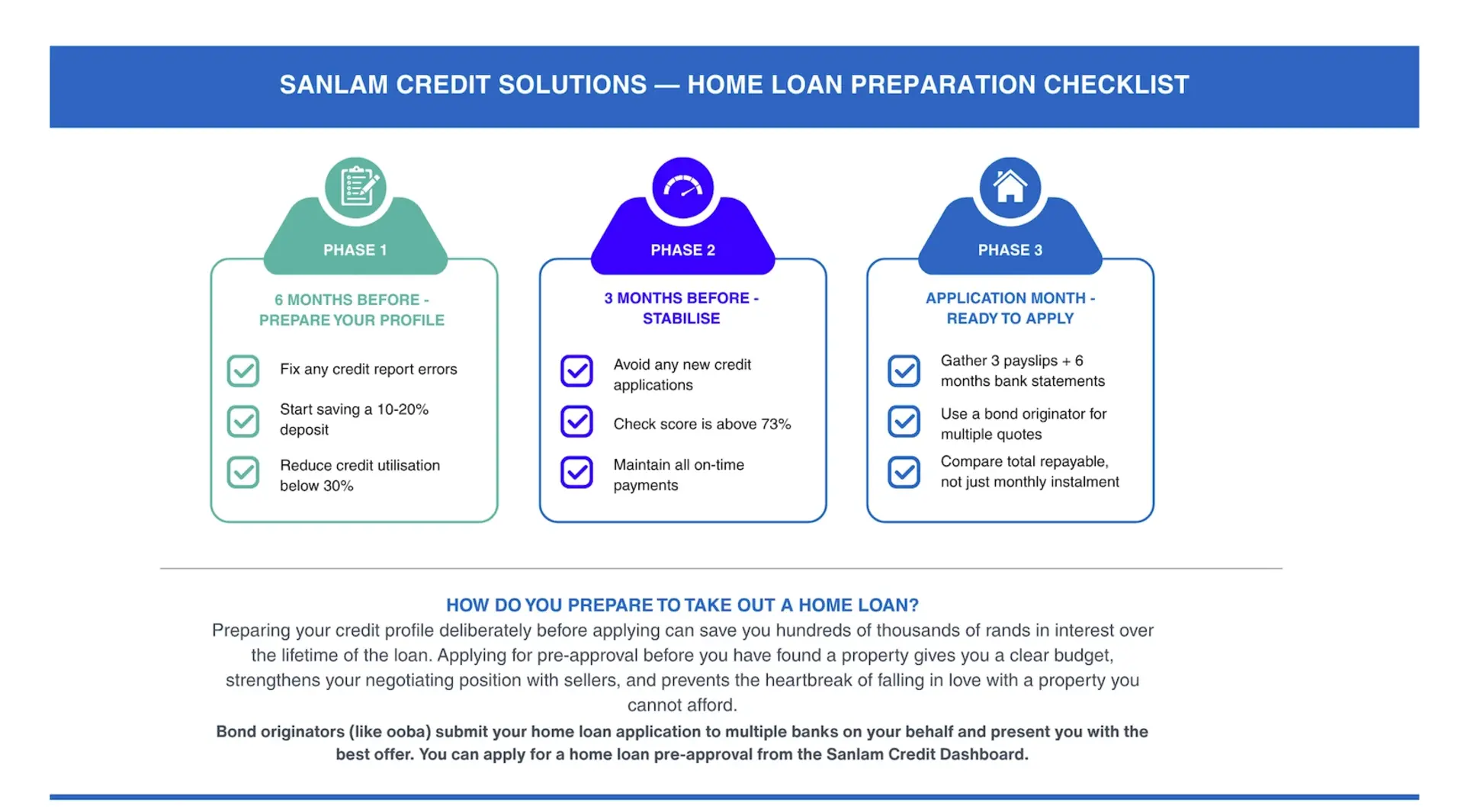
A home loan is the largest and most consequential credit decision most South Africans will make. Preparing your credit profile deliberately before applying can save you hundreds of thousands of rands in interest over the life of the loan. The best interest rate home loan SA applicants receive goes to those who arrive with a score above 82%, a clean credit report, and a deposit ready - this is the preparation checklist.
Credit score preparation:
Aim for a score above 82%before applying. This is the range where multiple banks will compete for your application and rate negotiation becomes viable.
Check your credit report for errors at least three months before applying. A single incorrect default can derail your application or increase your rate significantly.
Avoid new credit applications in the 3–6 months before your home loan application. Each hard enquiry lowers your score slightly. Enter the home loan process with a clean, stable profile.
Financial preparation:
Save a deposit of 10–20% of the purchase price. A deposit significantly improves both approval odds and the interest rate you qualify for. Lenders offering 100% bonds apply stricter credit requirements.
Ensure your total monthly debt repayments (including the new bond) will not exceed 28–30% of your gross monthly income. The affordability threshold most major banks apply.
Maintain at least 2 years of stable employment history before applying. Lenders look for income stability alongside credit score.
The pre-approval process: Applying for pre-approval before you have found a property gives you a clear budget, strengthens your negotiating position with sellers, and prevents the heartbreak of falling in love with a property you cannot afford. It is important to note, however, that pre-approval creates a hard enquiry so use it purposefully, not speculatively.
Bond originators (like ooba) submit your home loan application to multiple banks on your behalf and present you with the best offer. Their fee is paid by the bank making this a cost-free service for you. Use a bond originator to establish your baseline offer, then use that offer as leverage in a direct conversation with your own bank.
How Do You Prepare for Vehicle Finance in South Africa?
Vehicle finance is one of the most commonly accessed credit products in South Africa, and one where a strong credit profile makes a tangible difference to both approval and rate.
Major vehicle finance providers and their approximate credit score thresholds:
WesBank (FNB): Starts considering applications above 68%; competitive rates above 80%. Strong income stability is heavily weighted.
MFC (Nedbank Motor Finance Corporation): Similar threshold to WesBank. Known for competitive rates above 75% and for considering self-employed borrowers with documented income.
Standard Bank Motor Finance: Competitive rates above 80%. Preference for new vehicle finance over used vehicles at the same score.
Beyond credit score:
A deposit of 10–20% significantly improves your approval odds and the rate offered. Lenders see a deposit as evidence of saving discipline and reduced risk.
A newer, lower-mileage vehicle attracts better finance rates at the same credit score than an older, high-mileage one.
Always compare at least two or three vehicle finance offers before accepting. The rate difference between providers can be meaningful over a 60-month term.
How Do You Negotiate a Lower Interest Rate with Your Bank?
Negotiating your interest rate is one of the highest-value financial actions available to a South African consumer and most people either do not know it is possible or do not feel confident attempting it. Here is the system:
Know your credit score before the conversation. Use the Sanlam Credit Dashboard. If your score is above 80%, say so explicitly as it gives you a factual anchor for the negotiation.
Get competing quotes first. Approach at least three lenders and get their best rate offers. Competition is your most powerful tool. When Bank A knows Bank B has offered you a better rate, Bank A has a financial incentive to improve.
Prepare your documentation completely. Latest three payslips, six months of bank statements, ID, proof of residence, and a summary of your existing debts and assets. A well-prepared applicant signals a low-risk borrower.
Ask the direct question. 'Based on my credit profile and payment history, what is the best rate you can offer me and what would I need to change to qualify for an even better rate?' This is a professional, expected question.
Use your existing relationship as leverage. If you are renegotiating an existing bond or loan, years of on-time payments with that lender are your most valuable bargaining chip. Ask for a rate review formally.
Repeat annually. If your credit score has improved significantly since your loan was issued, go back and renegotiate. Many South Africans leave significant money on the table simply by not asking.
The prime rate context: South Africa's prime lending rate is 3.5 percentage points above the SARB repo rate. Most home loans are priced at prime plus or minus. A strong credit profile allows you to negotiate a better margin which protects you regardless of how the underlying rate moves.
How Do You Protect Yourself From Credit Fraud in South Africa?
A strong credit profile makes you a more attractive target for identity fraud. To prevent identity theft and credit fraud in South Africa, you need to understand how attacks happen and act before they do. Credit fraud typically takes three forms: ID document fraud (someone uses your ID to apply for credit), SIM-swap attacks (a fraudster takes over your mobile number to intercept OTPs), and account takeover (accessing an existing account fraudulently).
According to SABRIC (South African Banking Risk Information Centre), SIM-swap related fraud remains one of the fastest-growing fraud categories in the country. Attackers gather personal information from social media and phishing before approaching your mobile network.
Practical protection steps:
Monitor your credit profile monthly: any unexpected new enquiry or new account is an early fraud signal
Monitor your email inbox for monthly updates from Sanlam Credit Solutions: you are notified monthly when your bureau information is updated, even if nothing changes on your profile – it’s a reminder to log in and check your credit information
Register with SAFPS Protective Registration (see below): free for all South Africans
Never share your ID number, OTPs, or banking details via WhatsApp, email, or phone
How Does SAFPS Protective Registration Protect Your Credit Profile?
The Southern African Fraud Prevention Service (SAFPS) operates a Protective Registration system that flags your identity, requiring additional verification before any new credit application in your name can proceed. When your ID is on the SAFPS register, credit providers must take extra steps to confirm your identity.
Anyone can register. This is not limited to just fraud victims. There are no cost and no downside to registering. If your identity documents have ever been lost, stolen, or you have been a fraud victim, it is essential. If you simply want to add a layer of protection to a strong credit profile, it is a sensible precaution.
To register: Visit safps.org.za and complete the online form with your SA ID number and personal details. Registration is immediate and free. Once registered, any credit application using your ID triggers a mandatory additional verification step — significantly reducing the risk of fraudulent credit being opened in your name.
Should you freeze your credit report? South Africa does not have a formal 'credit freeze' mechanism equivalent to the US system. The closest equivalent is SAFPS Protective Registration. It does not prevent lenders from checking your profile, but it does flag your identity for mandatory additional verification before any new credit account can be opened. For most South Africans, SAFPS registration combined with monthly credit monitoring via the Sanlam Credit Dashboard provides comprehensive protection without the friction of a full freeze.
What Is Debt Counselling and When Should You Consider It?
Debt counselling in South Africa (more formally referred to as debt review) is a process under the National Credit Act for consumers who are genuinely over-indebted. Debt counselling in South Africa is not a last resort; it is a structured safety net for consumers whose monthly income is insufficient to cover all their debt repayments and living expenses. This is also known as being over-indebted.
How it works: An NCR-registered debt counsellor assesses your situation. If you qualify as over-indebted, they negotiate with all your creditors to restructure your repayments - typically extending the repayment period and reducing monthly instalments. A court order formalises the arrangement. You make a single monthly payment to a Payment Distribution Agency (PDA), which pays your creditors.
The credit profile impact: Your profile is flagged with a 'debt review' notation throughout the process. You cannot access any new credit while under debt review. After completing the process and receiving your clearance certificate, the notation is removed, but rebuilding your score will take 12–24 months of consistent behaviour.
The key protection: Debt counselling gives you legal protection from creditors taking legal action against you while the process is underway. For consumers who are genuinely over-indebted, this protection is the most valuable aspect.
Rebuilding after debt review: Confirm all bureaus have removed the debt review flag (this is not always automatic). Open one starter credit account. Manage it perfectly. Track your progress monthly on the Sanlam Credit Dashboard. The path from clearance certificate to home loan approval typically takes 24–36 months.
To find an NCR-registered debt counsellor: Visit ncr.org.za or call 0860 627 627. Never engage with a debt counsellor who is not on the NCR register as they have no legal authority to negotiate with your creditors.
Where to get a debt consolidation loan: If you are not over-indebted but want to simplify multiple repayments, a personal consolidation loan up to R350,000 from any registered lender could serve as an alternative to formal debt counselling.
Common Mistakes When Using a Strong Credit Profile
The Credit Ombud and ooba Home Loans both document these as the most common errors among experienced credit users:
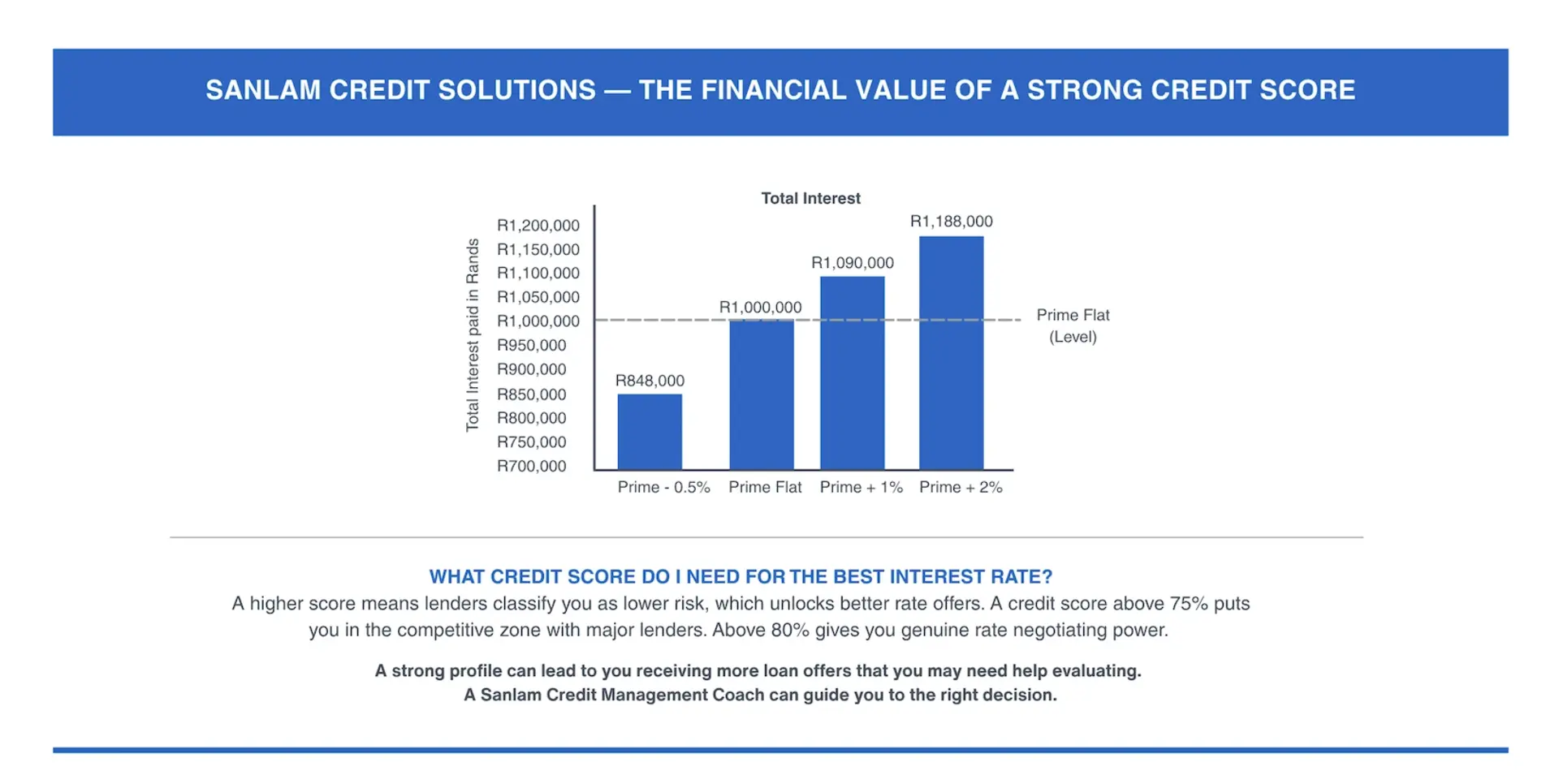
Not negotiating: Many South Africans accept the first interest rate offered. ooba notes that applicants with scores above 70% who negotiate receive meaningfully better margins. The difference on a R1 million home loan over 20 years can exceed R350,000 in total interest. Always ask: what is the best margin you can offer, and what would I need to do to qualify for prime minus?
Applying directly to multiple banks simultaneously: Thembi, 38, applied directly to FNB, Absa, and Standard Bank on the same day. Each was a separate hard enquiry. Her TransUnion score dropped from 741 to 718 before any bank had assessed her application. ooba and BetterBond both note that a bond originator submission counts as a single enquiry event thus preserving your score during the comparison process.
Skipping SAFPS Protective Registration: SAFPS (Southern African Fraud Prevention Service) offers free Protective Registration to all South Africans. SABRIC states that SIM-swap and identity fraud are growing fastest among consumers with established credit profiles. Registration takes under ten minutes at safps.org.za.
Entering debt counselling without understanding the full credit impact: The NCR explains that debt counselling flags your profile with a debt review notation for the full duration. You cannot access new credit during this period. The Banking Ombud notes that consumers who enter debt counselling for cash-flow management rather than genuine over-indebtedness often regret the credit restriction.
What credit score do I need for the best interest rate in South Africa?
Above 75% puts you in the competitive zone with major lenders. Above 80% gives you genuine rate negotiating power. The difference between prime minus and prime plus on a R1 million home loan over 20 years can exceed R350,000 making your credit score one of your most valuable financial assets.Does a higher credit score guarantee a lower interest rate?
Not automatically, but it gives you the leverage to negotiate one. A higher score means lenders classify you as lower risk, which unlocks better rate offers. However, each lender has its own risk model, and two lenders may offer different rates to the same applicant. This is why getting competing quotes from at least three lenders is essential and your credit score opens the door, but comparison shopping determines the rate you actually get.What is the best way to compare lenders in South Africa?
Use a bond originator like ooba for home loans. They submit to multiple banks simultaneously at no cost to you. For personal loans and vehicle finance, apply to your own bank first to establish a baseline, then get quotes from at least two competitors. Always compare the total repayable amount over the full loan term and not just the monthly instalment because a lower instalment with a longer term often costs significantly more in total.How many enquiries are allowed before home loan approval?
There is no official limit, but most SA mortgage underwriters become cautious when they see more than three to four hard enquiries within a six-month period as it signals that you have been applying for credit aggressively, which is a risk flag. When using a bond originator, multiple bank submissions typically count as a single enquiry event rather than individual hard enquiries, since they are made simultaneously and clearly for the same purpose.How do I negotiate a lower interest rate with my bank?
Know your credit score, get competing quotes from at least three lenders, prepare your documentation, and ask directly. If you have an existing track record of on-time payments with your bank, use it as leverage. Repeat the negotiation annually after significant score improvements.
How Do You Convert Credit Confidence Into Real Financial Opportunity?
A strong credit profile is not an end in itself. It is a financial asset - one that saves you money on every loan you take, opens doors to financial products that were previously unavailable, and gives you the confidence to approach major financial decisions from a position of strength.
The rand difference between a good and great credit score on a home loan is not a small number. Over a 20-year bond, it can be the difference between building wealth and servicing debt. That is what credit confidence means. That is what every article in this series has been building towards.
Track your credit score every month on the Sanlam Credit Dashboard. Set up your money management processes and fraud alerts. Know your rights. And when the time comes — walk into that bank knowing exactly what your credit profile is worth.