Key takeaways from the 2026 National Budget

1. Introduction
Gross tax revenue for 2025/26 is revised upwards by R21.3bn compared with the 2025 Budget. The tax‑to‑GDP ratio increases to 25.9%. The R20bn tax increase previously penciled in for the 2026 Budget is withdrawn. Personal income tax brackets and medical tax credits will be adjusted for inflation, after two years with no inflationary relief. Certain tax thresholds and limits are also adjusted for the impact of inflation, to assist small businesses and encourage savings.
2. Proposals Affecting the Retirement Fund Industry
2.1 Retirement fund contribution deduction limits
Currently, members contributing to a retirement fund may receive a tax deduction for contributions made to a retirement fund of up to 27.5% on the greater remuneration or taxable income, but not more than R350,000 per annum. This means that a member may not deduct contributions for tax purposes of more than the annual limit of R350,000. This amount will be increased to R430,000 effective 1 March 2026.
Comment: This increase is welcomed and will encourage members to save more for their retirement through contributions to a retirement fund. There is however still considerable room for improvement considering the previous limit was set in 2016.
2.2 Retirement Interest de minimis (commutation) Threshold for Annuitization
Currently, at retirement, everything in the retirement component must be used to purchase an annuity – subject to the de minimis amounts which are calculated cumulatively across the entire retirement component and the non‑vested portion of the vested component. The current de minimis is R247,500. This de minimis will be increased to R360,000 effective 1 March 2026.
Comment: The adjustment will allow for more cost‑effective annuitisation for members with smaller retirement values.
2.3 Living Annuity Commutation
The cnoditions for when a living annuity may be commuted is set out in the Income Tax Act. Paragraph (c) of the definition of living annuity in the Income Tax Act deals with commutation of a living annuity. It provides that the full remaining value of the living annuity may be paid in a lump sum when the value at any time becomes less than the amount prescribed by the Minister of Finance. The current prescribed amount of R125,000 will be increased to R150,000.
Comment: This only applies to a living annuity as defined in the Income Tax Act and does not apply to a guaranteed life annuity. No commutation is possible in respect of a guaranteed life annuity.
2.4 Determining the Application of The de minimis (commutation) Limit for Multiple Living Annuities Held with the Same Insurer or Fund
The Income Tax Act allows a living annuity to be commuted and paid as a lump sum when the value of the assets falls below the prescribed de minimis limit, currently set at R125,000 (which will be increased to R150,000 as of 1 March 2026). This limit is applied on a per‑insurer or per‑fund basis, depending on whether the living annuity is provided by the fund or purchased from an insurer, whereby the value of all living annuities held by an annuitant with the same insurer or fund is aggregated when applying the limit. However, differing interpretations of the law exist regarding whether this limit applies per policy or cumulatively per insurer or fund. Applying the limit on a per‑policy basis could undermine retirement income security by enabling the early commutation of multiple small annuities and facilitating tax‑driven restructuring of retirement assets. It is therefore proposed that the definition of “living annuity” in section 1 of the Income Tax Act be amended to explicitly provide that the prescribed de minimis limit must be determined cumulatively where an annuitant holds multiple living annuities with the same insurer or fund.
Comment: Clarity on this interpretation will ensure consistent application of the de minimis principle across the industry.
2.5 Unclaimed Assets
Government is implementing a reform to centralise the management and investment of over R88bn in unclaimed financial assets, which include retirement benefits, bank accounts, investments and insurance payouts. This reform aims to ensure that the benefits of these assets accrue to the asset owners rather than to financial institutions, the government or any other parties.
The proposed framework provides for the transfer of these assets to a central manager to drive down costs and improve payouts with appropriate governance for investment, alongside the appointment of a central administrator responsible for administration, record‑keeping and tracing. The reform will be rolled out in phases, starting with the retirement fund sector, given its established identification and monitoring systems. Over time, the framework will be extended to other categories of unclaimed financial assets.
The centralisation of unclaimed financial assets seeks to address challenges associated with fragmented administration, inconsistent definitions and the erosion of value through fees. A unified system, supported by a central database and an administrator, is intended to strengthen tracing processes and enhance transparency. It is also expected to provide beneficiaries with a clearer and more streamlined claims process. A discussion note will be released shortly for public consultation.
Comment: This has been on the agenda for a number of years. It remains critical that sufficient time is allowed for the tracing of beneficiaries before assets are transferred to a central unclaimed assets fund, where active tracing is unlikely to occur. The central unclaimed assets fund will further have to be subject to rigorous regulation and oversight to ensure the proper functioning thereof and to prevent possible corruption and fraud.
2.6 Infrastructure Investing
The Minister indicated that infrastructure is attracting significant private sector investment. National Treasury and the Development Bank of South Africa is currently setting up the Infrastructure Finance and Implementation Support Agency. The key focus areas are electricity transmission, transport, water, telecoms and visas. There are currently 63 public‑private partnerships/projects that are being managed.
Comment: The fact that National Treasury launched infrastructure bonds in 2025 and raised R11.8bn that was oversubscribed 2.2 times, is of interest to retirement funds that are encouraged to disclose their infrastructure investments.
3. Other Matters of Interest
3.1 Individuals, Employment and Savings
3.1.1 Allowing rollover treatment of capital allowances on allowance assets transferred between spouses
The Income Tax Act regulates the transfer of assets between spouses through section 9HB of the Act. This provision establishes a rollover mechanism for the transfer of trading stock, livestock and capital assets between spouses. However, the recoupment component of the rollover for allowance assets is not provided for, as section 9HB does not prevent the recoupment of capital allowances in the hands of the transferor spouse under section 8(4)(k) of the Act, nor does it allow the transferee spouse to take over the accumulated allowances previously claimed. It is proposed that section 9HB be amended to prevent the recoupment of capital allowances on the transfer of allowance assets between spouses and to provide for the carry‑over of accumulated allowances to the transferee spouse.
3.1.2 Limiting the donations tax exemption rules where a spouse ceases to be a tax resident
Section 56 of the Income Tax Act exempts donations between spouses from donations tax. Government has become aware of tax avoidance arrangements, particularly involving high‑net‑worth individuals planning to cease to be South African tax residents. The arrangement involves deliberately staggering the cessation of tax residence between spouses where significant assets are transferred to a spouse who has already become non‑resident before the remaining spouse ceases residence. In these circumstances, the donations tax exemption applies, while the subsequent cessation of tax residence by the remaining spouse results in a reduced income tax liability under section 9H of the Act. These arrangements are designed to avoid both donations tax and the income tax on cessation of residency, undermining the original policy intent of these provisions. It is proposed that the donations tax exemption rules applicable to spouses be limited to donations made to a spouse who is a resident effective from 25 February 2026.
3.1.3 Limiting the donations tax exemption rules where a spouse ceases to be a tax resident
Section 56 of the Income Tax Act exempts donations between spouses from donations tax. Government has become aware of tax avoidance arrangements, particularly involving high‑net‑worth individuals planning to cease to be South African tax residents. The arrangement involves deliberately staggering the cessation of tax residence between spouses where significant assets are transferred to a spouse who has already become non‑resident before the remaining spouse ceases residence. In these circumstances, the donations tax exemption applies, while the subsequent cessation of tax residence by the remaining spouse results in a reduced income tax liability under section 9H of the Act. These arrangements are designed to avoid both donations tax and the income tax on cessation of residency, undermining the original policy intent of these provisions. It is proposed that the donations tax exemption rules applicable to spouses be limited to donations made to a spouse who is a resident effective from 25 February 2026.
3.1.4 Increase in annual contribution limit to tax-free investments
Currently, contributions to a tax‑free investment are limited to R36,000 per annum, which annual limit has been in place since 2021. The annual limit will be increased to R46,000.
Comment: This adjustment is welcomed to help improve savings in the country. However, it is regrettable that the lifetime contribution limit has not been adjusted accordingly.
3.2 Preparing for the 2026/27 Financial Action Task Force (FATF) mutual evaluation
South Africa exited the FATF grey list in October 2025. Preparations have begun for the next round of assessment, from mid‑2026 to October 2027. Regulatory and legislative measures to further bolster the financial system’s ability to combat financial crime will be brought to Parliament early in 2026. These include the General Laws (Anti‑Money Laundering and Combating Terrorism Financing) Amendment Bill, which the National Treasury published for public comment in January 2026. The draft bill proposes amendments to the Financial Intelligence Centre Act, the Financial Sector Regulation Act, the Companies Act and the Nonprofit Organisations Act (1997), and seeks to address some technical deficiencies.
3.3 Implementation of an Open Finance Framework
Open finance is the framework that allows individuals and businesses to safely share their financial data with third‑party providers, with their explicit consent, in order to access better, more competitive and more innovative financial products and services. It has the potential to drive down the cost of financial services for individuals and businesses. In 2025, the Intergovernmental Fintech Working Group (IFWG) finalised a comprehensive cost‑benefit analysis that set out concrete recommendations to guide the implementation of an open finance framework in South Africa. Over the next financial year, the IFWG will continue with work to develop an appropriate regulatory framework for open finance.
3.4 Regulating Artificial Intelligence in the Financial Sector
The Financial Sector Conduct Authority (FSCA) and the Prudential Authority undertook a survey on the adoption of artificial intelligence (AI) in the South African financial sector. This study provided insights into the usage and adoption of AI in the sector. The FSCA, the Prudential Authority and the Reserve Bank are collaborating to develop a discussion paper, based on the survey, to be published in July 2026. The paper will set out recommendations for the safe and responsible adoption of AI in the South African financial sector, with a view to developing a formal joint regulatory instrument.
3.5 Exploring the impact of Influencers on Financial Consumers’ Decision-making
The FSCA is conducting a market study to explore the impact of influencers on financial consumers’ decision‑making processes. As social media gains prominence as a significant source of information, financial information and, in particular, the role of financial consumer influencers – so‑called “finfluencers” – has become more pronounced. The market study will be published in 2026.
3.6 Advancing Climate-risk Resilience in the Financial Sector
Government continues to work to strengthen responses to climate‑related and broader sustainability risks through the development of regulatory and supervisory tools. The Prudential Authority and the FSCA are assessing banks’ and insurers’ climate‑related governance, risk practices and disclosures. The intention is to evaluate the maturity of these industries regarding their responses to climate risks, and closely monitor the links between climate‑related financial risks and nature‑related risks and biodiversity loss. In 2026, the National Treasury will publish a consultation paper on transition planning by financial institutions to provide a framework for the content and nature of strategic planning that these institutions should undertake to address climate‑related risks. These plans should include climate‑related governance, risk practices and disclosures.
3.7 Capital Flows Management Framework
The National Treasury will publish amendments to the Exchange Control Regulations under the Currency and Exchanges Act. The amendments aim to include crypto assets in the capital flows management framework to complement regulation by the FSCA, which officially declared crypto assets (like Bitcoin and Ethereum) to be “financial products” under the Financial Advisory and Intermediary Services Act from October 2022. Similar regulatory action has been taken by the Financial Intelligence Centre, which in 2025 designated crypto asset service providers as accountable institutions subject to supervision, including reporting, registration and enforcement.
3.8 Single Discretionary Allowance
To take into account inflation and currency fluctuations, the single discretionary allowance limit for private individuals is increased from R1 million to R2 million per calendar year via Authorised Dealers for all purposes, including travel, gifts, remittances, investments and donations. Permitted single discretionary allowance transfers via Authorised Dealers in foreign exchange with limited authority are increased from R1 million to R2 million. The limit will be reviewed regularly.
3.9 National Online Gambling Tax
The National Treasury published a draft national online gambling tax discussion paper for public comment in November 2025. It proposed a tax of 20% on gross gambling revenue generated by online gambling. This tax would be in addition to the current taxes paid to provinces. The public comment period was extended to close on 27 February 2026. Following receipt of the comments, the National Treasury will hold a workshop with those who commented. A proposal, including any revisions from the consultation, will be included in draft legislation that will be made available for public comment later in the year. Comment: The uptake in online gambling is of significant concern, in particular when members make use of their annual savings pot withdrawal to fund such activities.
3.10 Collective Investment Schemes
Following public consultation after the publication of the discussion paper on collective investment scheme (CIS) taxation in 2024, the National Treasury will release a response document with revised proposals for further consultation. The draft recommendation in the response document proposes that all investment returns generated by regular CISs and retail investment hedge funds be taxed as capital. This is to encourage savings and to provide the industry with certainty about the tax treatment of these savings vehicles. CISs and retail investment hedge funds are open to the general public, are well regulated and have diversification and other requirements, providing an important avenue for savings. By contrast, qualified investment hedge funds are not open to the general public, have minimal investment criteria and only cater for those able to invest a minimum of R1 million. Government will propose excluding such qualified funds from the CIS tax regime. Alternative tax regime options for these funds will be proposed in the response document.
3.11 Public Sector Early Retirement Programme
Government has begun implementing its Early Retirement Programme to rejuvenate the public‑sector workforce and manage compensation costs. Since the programme commenced in October 2025, 7,687 applications have been approved, while R3.7bn of the available amount has been drawn down. The estimated net saving from this programme is R5.5bn, of which R2.6bn will be realised in 2026/27, R1.4bn in 2027/28 and R1.5bn in 2028/29.
4. Personal income tax
4,1 Income tax brackets
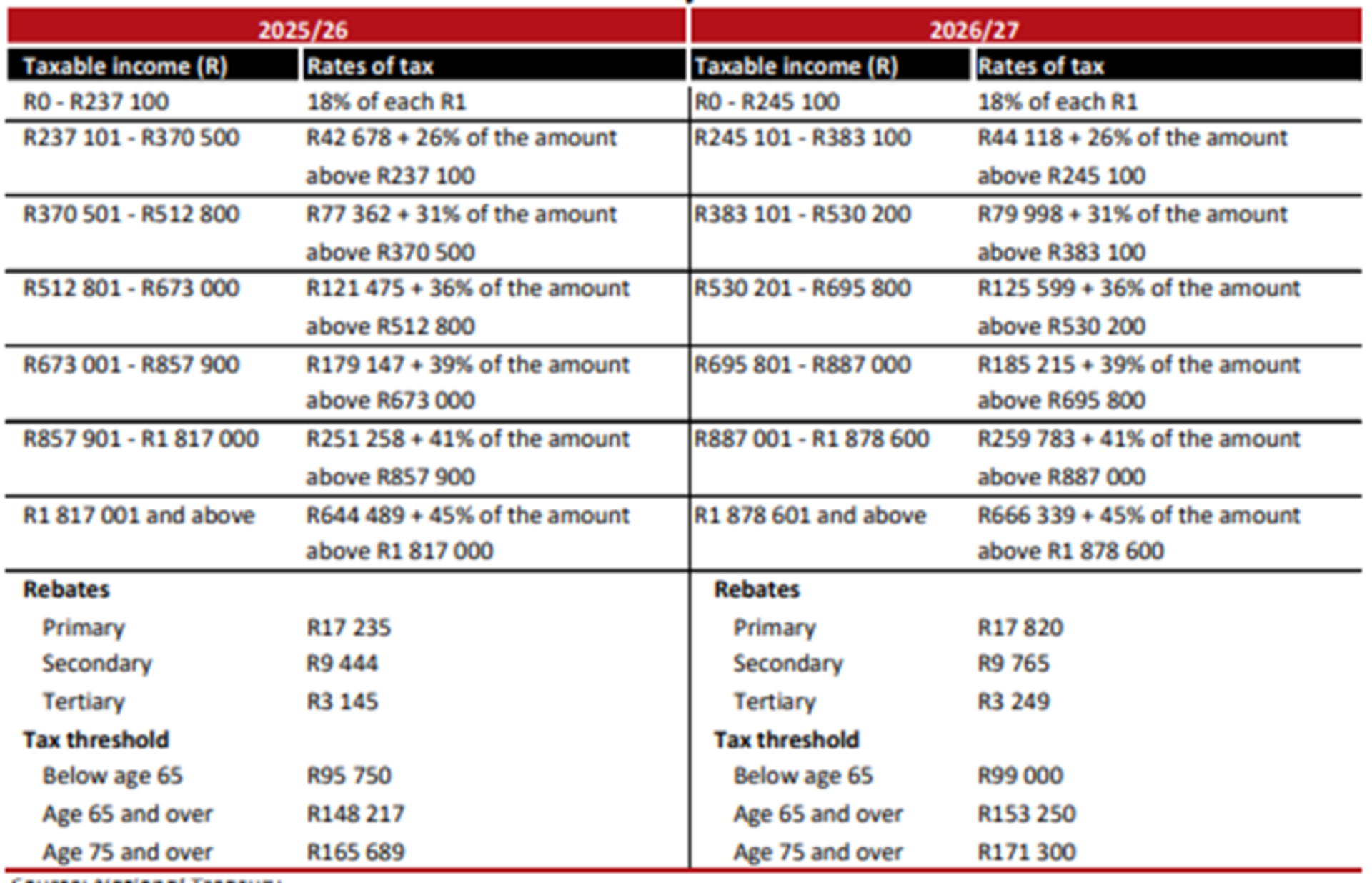
In 2026/27, personal income tax brackets and rebates will be adjusted in line with expected inflation (3.4%) – this is the first increase since 2023/24. The personal income tax brackets and rebates are increased as per the table:
Comment: The adjustment of income tax brackets and rebates provides taxpayers with relief from the impact of inflation on their tax payments for the first time since 2023/24 and is much welcomed.
4.2 Medical Tax Credits
Medical tax credits will increase from R364 to R376 for the first two members, and from R246 to R254 for additional members.
Comment: This increase in medical tax credits is welcomed as it makes it more affordable for people to remain members of medical aid schemes.
4.3 Social Grants
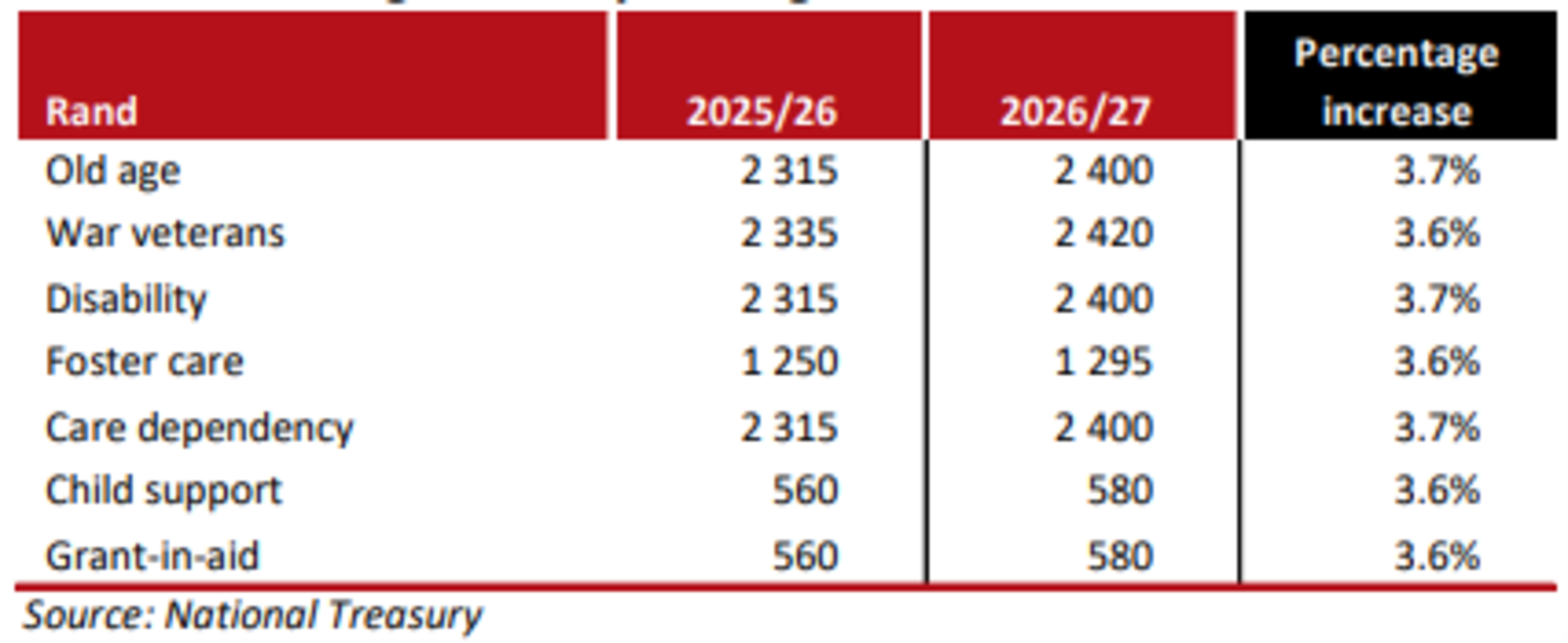
The old age grant, disability grant and care dependency grant will increase to an average maximum of R2,400 in April 2026, while the war veterans grant increases to R2,420. The foster care grant will increase to R1,295. The child support grant and grant‑in‑aid grant rise to R580. The social relief of distress grant is allocated an additional R36.4bn to extend payments until 31 March 2027 at the current R370 per month per beneficiary.
The social grant increase is as per the table:
Comment: Currently 4.199 million people over the age 60 are receiving state old age grants. South Africa has approximately 6.2 million people over the age of 60. This means that more than 70% of people over the age of 60 are receiving an old age grant.
Contributors: Lize De La Harpe, PG Marais, Anita Roodman, Mpho Kgomongoe, Danie van Zyl, Dirk Oosthuizen.